I often get question what is Kanban and if it is better than Scrum. So let us start with explanation of what Kanban is. It’s a very light method coming from ancient Japan and then popularized by Toyota. It has three rules:
- Limit work in progress (WIP)
- Visualize
- Minimize lead time
That’s all. You can start with any process, visualize it and based on what you see improve the throughput and bottlenecks. It’s simple, it works. But you have to be really improving based on what you see. Companies are often going to Kanban because the change required by real Scrum is too painful. So they do some board (you can’t usually see much from it), and say we are done.
Because Kanban doesn’t really help you with implementation and mindset change, Scrum is so successful comparing to Kanban (I’m not saying that Scrum is simple, but the opposite). So if you truly think about the three above principles, you find out that Scrum actually embraces Kanban at many levels. So let’s go one by one.
Limit work in progress (WIP)
In Scrum we have Sprint backlog to fix number of backlog items / User Stories in Sprint.
It’s a common practice to say that each person can work at one task at a time. Once it’s done they can take another one. Two (and more) people can work on one task to make it done faster.
Successful teams work one UserStory at a time. As a team, they take one Backlog Item and finish it. Once it’s done, they take another one and collaborate on it.
Visualize
Sprint backlog is visible, defined, well understood.
Common practice is to have Scrum board to visualize sprint progress and help team members collaborate.
We make our backlog and priorities visible to everyone.
Sprint review shows the done functionality every Sprint.
Minimize Lead time
Sprint Backlog and Definition of Done is here to make sure teams finish working software each Sprint.
Scrum says the shorter Sprint, the better. So most of the teams now have two weeks Sprints and there is strong trend to one week Sprint.
Common Kanban/Scrum misunderstanding
One of the most common misunderstandings and reasons why people choose Kanban and leaving Scrum is that we can’t deliver working software any time during the Sprint in Scrum. We have to wait to the end of Sprint they say. But there is nothing in Scrum which would prevent you from continuous delivery. The only changes you need to do regarding team practices (note it has nothing to do with Scrum itself) is to adjust your definition of done (DoD) by adding “running on production server” and let team to work ‘one Story at a time’ so they deliver done functional stories one by one. Any time during the Sprint they are done with that story (done means it’s according to the DoD) the functionality is already at the production. Simple and straightforward 🙂 right?
So all around, there is no reason to leave Scrum. By the way, if it’s not fun to be Scrum, it’s most likely not Scrum, so inspect and adapt the way you work. If you are looking for some useful tools how to make it working and how to make it more fun, you can check my new book The Great ScrumMaster.
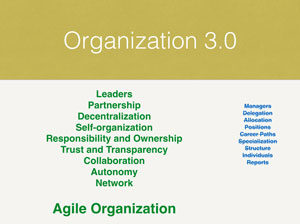
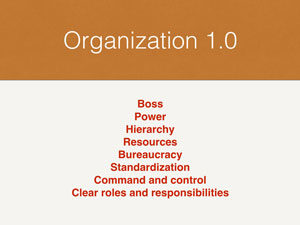 Those pyramid hierarchical structures were not wrong in any way. They were the perfect solution to world industrialization and to the dynamics of business at that time. Most of the companies followed the best practices for a simple world, where problems can be classified as obvious, and applied a simple structure to address it. And it worked. Bosses got results. Companies started growing and became more successful.
 The most common management tool was a carrot and a stick, because organizations believed that their employees are lazy slackers who can’t work without it. Most of the people were in a mood of tribal leadership 2 where the motto is “my life sucks”. Complaining all the time. Not happy, not motivated. Their only motivation to do something was driven by getting some bonus – a carrot, or because they were forced to – a stick.
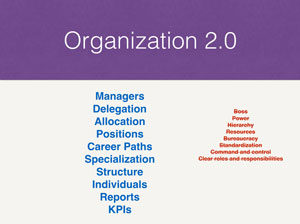 Organizations are trying to create a process to describe everything, to have every possibility thought over. Companies create career paths and talk about motivation. They have spent months describing KPIs, but the more processes and specializations they had, the less responsibility and goal driven individuals they had. They were starving. They tried to cut on expenses, but that did not bring any long term success either.
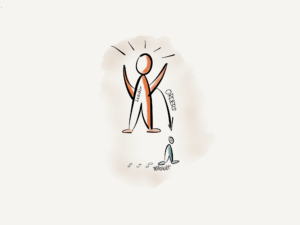 The pressure on individuals to make themselves more successful, better, and smarter than others was huge. “What if my colleague is be better in the performance review?” “What if I am not promoted in two years?” It leads to a culture that emphasizes own goals over the organizational ones. Most of the managers and experts live in the third level of the tribal leadership model, where they believe that “I’m great, but you are not.” So they treat their employees and colleagues with little respect or trust. This leads to the leadership style of “leader-follower”, where the managers decide, and the people below them just do the job. No initiative is expected. People just follow the process and do what is ordered.